
The business impact in 30 seconds:
- Sales reps lose selling time to shadow accounting when commission accuracy is questionable
- Finance teams report month-end query spikes that delay strategic work
- Top performers interview elsewhere when trust in variable pay erodes
- Narrow buyer engagement windows (17% of total buying time) make rep distraction particularly costly
Finance operations research demonstrates that commission accuracy issues trigger a multi-stage productivity cascade. The initial dispute consumes finance bandwidth, but the larger cost emerges when sales representatives redirect energy from client engagement to payment verification. In B2B contexts where buyer contact time remains severely constrained, this distraction carries direct revenue consequences that compound across quarters.
Understanding the complete economic impact requires tracking four distinct cost layers: direct resolution time, sales opportunity cost, retention risk value, and management overhead. Each layer amplifies the others, creating total costs that typically exceed surface estimates by 300 to 400%. The organisations that quantify this full spectrum position themselves to make evidence-based decisions about process transformation rather than treating disputes as inevitable administrative friction.
Why commission disputes drain more than your finance team’s time
The immediate cost appears straightforward: finance team hours spent reconciling queries, checking formulas, and explaining variances. What operational data reveals is a multi-layer productivity drain that extends across departments and compounds monthly. As Salesforce’s 2026 sales statistics confirm, 42% of sales representatives feel overwhelmed by administrative tools, and overwhelmed sellers are 45% less likely to attain quota. Commission disputes directly contribute to this administrative burden when representatives resort to shadow accounting to verify their pay.
Consider the selling time gap: the same Salesforce research finds representatives spend only 28 to 30% of their time actually selling, with administrative tasks consuming the rest. When commission calculations prove opaque or error-prone, that fraction shrinks further as high performers dedicate hours to cross-referencing CRM deal data against payment statements. At an opportunity cost of roughly 150 GBP per hour in lost selling activity, a senior account executive spending five hours monthly on commission verification represents $9,000 annually in foregone pipeline development.
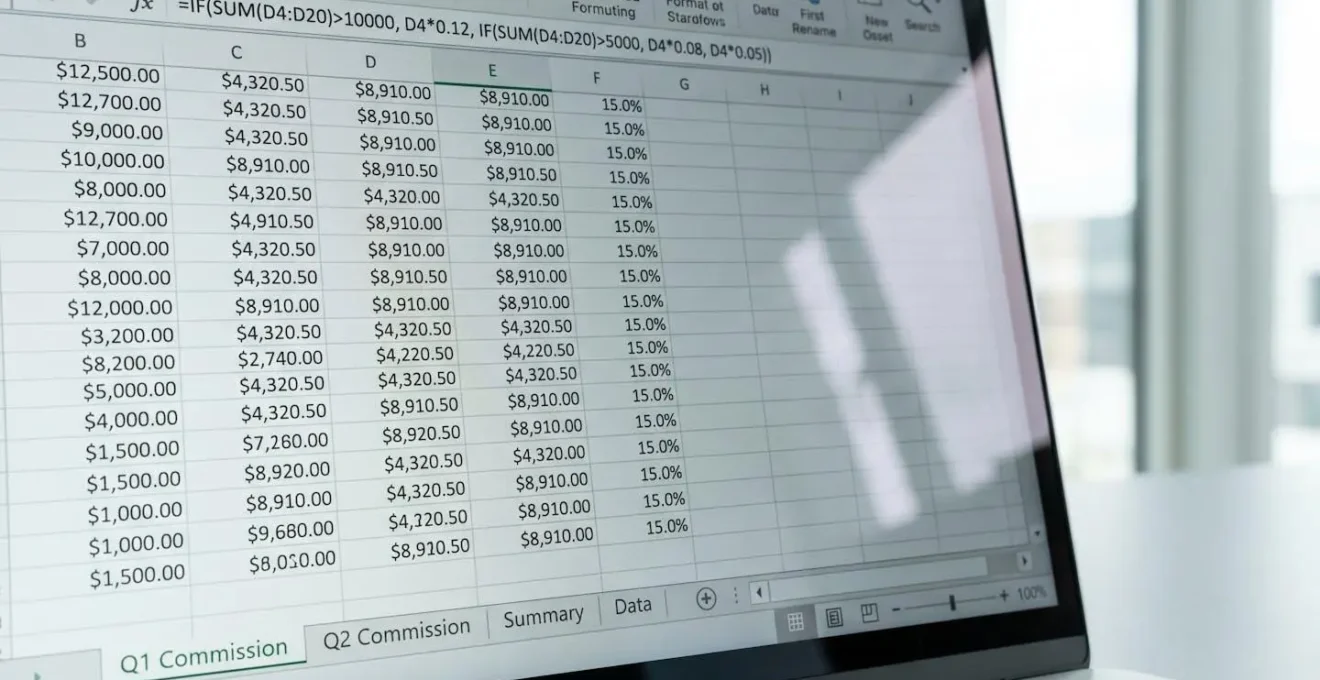
The calculation error trap: Most finance teams calculate only the hours spent resolving disputes, overlooking the larger cost — sales representatives spending time questioning their pay instead of closing deals.
The ripple extends to management bandwidth. When disputes escalate beyond finance team resolution, sales directors and operations managers step in to mediate. Industry experience suggests these escalations consume an average of two to three hours per incident when documentation review, clarification calls, and follow-up communication are factored in. For a mid-sized sales organisation experiencing eight to ten escalated disputes quarterly, that represents nearly 100 hours of management time annually diverted from strategic priorities such as territory planning, coaching, and market development.
The ripple effect: from calculation errors to talent exodus

The progression from initial dispute to eventual departure follows a documented pattern. What begins as a single query about accelerator calculations or tier threshold timing can evolve into systematic distrust when resolution proves slow or explanations remain unsatisfactory. Operational experience across sales organisations demonstrates that unresolved commission concerns create cumulative morale erosion rather than isolated incidents.
In a typical sequence, the first dispute prompts a representative to build their own tracking spreadsheet, duplicating finance team effort and signalling eroded confidence. When subsequent pay periods generate further variances, the representative escalates to management, consuming director bandwidth. If resolution timelines stretch beyond two to three weeks, conversations with recruiters often begin. By the time formal resignation occurs, the organisation has already absorbed dispute resolution costs, lost selling time, and diminished team morale as colleagues observe the friction.
From dispute to departure: a 90-day timeline
A high-performing enterprise account executive closes a complex multi-year contract in Q2, triggering accelerators and tier advancement. Month-end commission statement shows lower-than-expected payment due to a spreadsheet formula error treating the contract as single-period rather than recognising upfront value per company policy. Week 1: Initial query submitted to finance. Week 3: Finance acknowledges formula error but requires approval cycle for correction. Week 6: Correction approved but payment delayed to following month due to payroll cut-off. Week 8: Representative confides to peers about « ongoing commission issues ». Week 10: Recruiter contact yields interview at competitor citing « more transparent compensation structure ». Week 12: Resignation submitted. Replacement cost: approximately $50,000 including recruitment, onboarding, and ramp time.
The retention impact extends beyond individual cases. The Sales Compensation Trends Survey reveals that employee turnover in sales is expected to fall to 9% in 2024, down from 14% in 2022 — a 35% reduction that underscores how compensation plan quality directly influences retention economics. The same research identifies pay as the top reason candidates join or leave organisations, making commission accuracy a direct lever on talent acquisition costs.
Quantifying the opportunity cost of manual commission processes
Constructing a comprehensive cost framework requires moving beyond visible dispute resolution hours to capture the full economic impact across four layers: direct finance time, sales productivity opportunity cost, retention risk value, and management overhead. Each layer compounds the others, creating total costs that typically exceed initial estimates by 300 to 400%.
| Cost Category | Time/Impact per Incident | Monthly Cost (25-person team) | Annual Cost |
|---|---|---|---|
| Finance dispute resolution | 2-3 hours per dispute | $540 (6 disputes) | $6,480 |
| Sales rep shadow accounting | 4-6 hours per affected rep | $3,600 (4 reps affected) | $43,200 |
| Management mediation | 2-3 hours per escalation | $475 (2 escalations) | $5,700 |
| Retention risk (replacement cost) | 1 departure per 18 months | $3,055 (amortised) | $36,660 |
| Total annual impact | — | — | 92040 GBP |
This framework demonstrates why superficial time-tracking underestimates true cost. The largest component — sales productivity opportunity cost — rarely appears in finance reports yet represents the most significant drain on growth potential. According to data from organisations that have transitioned to automated commission management, typical time savings reach approximately five days per month across finance and sales operations combined, with corresponding improvements in sales team performance metrics showing increases around 15% when representatives gain real-time commission visibility and redirect energy from administrative verification to client engagement.
The opportunity cost becomes particularly acute in B2B contexts where buyer engagement windows remain narrow. Buyers spend only 17% of their total buying time in direct contact with potential vendors across all considered suppliers. When sales representatives lose productive hours to commission disputes during active buying cycles, they forfeit an already constrained engagement opportunity that competitors may capture instead.
Building commission transparency without spreadsheet dependency
Transitioning from manual commission processes to automated transparency requires confronting the fundamental limitations of spreadsheet-based calculations whilst preserving the flexibility that complex compensation plans demand. The core challenge lies not in abandoning spreadsheets entirely but in eliminating their role as the system of record for variable pay calculations where formula errors, version control failures, and data entry inconsistencies create the dispute triggers documented above.
- Direct CRM integration eliminates manual data entry and associated error risks
- Real-time commission visibility as deals progress through pipeline stages
- Audit trails documenting calculation logic for every transaction
- Scalability as sales team grows without proportional finance team expansion
- Representative self-service reducing query volume to finance teams
- Formula errors compound across linked worksheets and calculation periods
- Month-end calculation bottlenecks delaying payment transparency
- Version control failures when multiple stakeholders modify working files
- Limited audit capability making dispute resolution time-intensive
- Scalability constraints requiring additional finance headcount as team grows
The strategic shift involves recognising commission management as a performance enablement function rather than purely administrative overhead. When representatives gain transparent visibility into how specific deals contribute to their earnings, commission structures function as intended — directing behaviour toward strategic priorities and rewarding desired outcomes. When opacity and errors dominate the experience, the same structures generate friction, distrust, and the productivity drains quantified earlier.
Implementation considerations extend beyond software selection to process redesign and change management. Finance teams accustomed to month-end batch processing may initially resist real-time calculation approaches, citing complexity concerns or control preferences. Sales leadership must champion the transition by framing it as a retention and performance investment rather than a finance efficiency project, given that the primary beneficiaries are representatives who gain clarity and managers who reclaim time from dispute mediation.
How quickly do commission disputes typically get resolved in manual systems?
Resolution timelines vary by complexity, but operational experience suggests straightforward disputes require one to two weeks including approval cycles and payroll coordination. Complex disputes involving multi-period contracts or tier threshold timing can extend to four to six weeks, particularly when they require manager escalation and policy clarification. Automated systems reduce most disputes to minutes by providing transaction-level calculation transparency and audit trails.
What return on investment timeline should organisations expect from commission automation?
Organisations typically observe measurable returns within three to six months as finance team time redirects from dispute resolution to strategic work and sales representatives regain productive selling hours. The retention benefit — avoiding costly departures triggered by compensation trust issues — may take longer to materialise but represents the largest value component. Comprehensive ROI including productivity gains, retention impact, and scalability benefits generally becomes evident within 12 to 18 months.
Can automated systems handle complex commission structures with multiple tiers and accelerators?
Modern platforms are specifically designed to manage complexity that overwhelms spreadsheet approaches, including multi-tier structures, performance accelerators, team-based splits, quota retirement rules, and claw-back provisions. The key capability is rule-based calculation engines that apply consistent logic across all transactions whilst maintaining transparency into how each rule affected individual payments.
How does CRM integration reduce commission calculation errors?
Direct integration eliminates the manual data transfer step where most errors originate — copying deal values, dates, and attributes from CRM into commission spreadsheets. When commission systems pull data automatically from the CRM system of record, calculations reflect actual closed deals without transcription errors, version mismatches, or timing delays. Integration also enables real-time commission visibility as representatives update deal stages.
- Track finance team hours spent on commission queries over the next 60 days to establish baseline
- Survey sales representatives anonymously about commission transparency and trust levels
- Calculate full-cost replacement value for top-performing representatives at risk
- Document current dispute resolution timeline from initial query to final payment correction
- Assess CRM data quality and integration readiness for automated commission calculation
Rather than viewing commission disputes as inevitable administrative friction, the data presented throughout this analysis supports treating them as a measurable constraint on business growth. The organisations that quantify the full cost — across finance efficiency, sales productivity, and talent retention — position themselves to make evidence-based decisions about process transformation. The question is no longer whether manual commission processes carry hidden costs, but whether those costs exceed the threshold that justifies investment in transparency and automation.